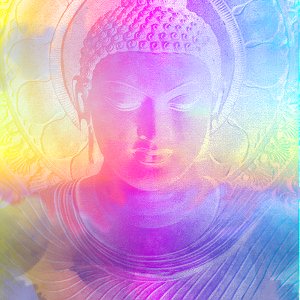
Buddhism Rev. Peter A. Somogyi
Final Dissertation
After 7 years of wondering in the wilderness, meditating, fasting and studying with many great Yogis and religious teachers, Siddhattha Gotama (Pali) realized that if was to attain understanding he would have to achieve this totally on his own.
Resolved to attain enlightenment the resolute prince set down under a great Pipal tree (1) and vowed: “Let my skin whither, my limbs grow numb, my bones dissolve, I will not rise from here until I attain Understanding" (2) The determined prince sat under the great Bo tree for 7 days and 7 nights meditating steadfast and as he sat there the veil of ignorance was lifted in his mind layer by layer. When he finally rose from his meditations "a new religion" arose with him. The Buddha then went to "Deer Park" where he met up with his former colleges (ascetic seekers) and to them he revealed the essence of his teachings.
The main tenets of Buddha's teachings include the idea that there is no Supreme Being or (God) who governs men's affairs or who sits in judgment over man's destiny. (3) Rather it is believed that man is his own master and determines his own growth as a human being and is able to attain enlightenment trough his own efforts. "One is one's own refuge, who else could be the refuge" said the Buddha. (4) The Buddha then admonished his disciples to take refuge in themselves and never to seek refuge or help form others.
In addition to the above the Buddha expounded what was reveled to him in his meditations which include the Four Noble Truths, the correct form of Mental Culture and Meditation (Bhavana) and the concept of Universal Love, (Metta - Sutta).
The Four Noble Truths
The Four Noble Truths, (Cattari Ariyasaccani) as expounded by the Buddha is the most important part of the Buddha's teaching .
These are:
Dukkha: (suffering, pain sorrow, emptiness, imperfection, impermanence, insubstantiality)
Samudaya: (the arising or origin of dukkha)
Nirodha: (the cessation of dukkha)
Magga: (the way leading to the cessation of dukkha, which is the "Noble Eight-fold Path")
The First noble Truth; (Dukkha):
Dukkha or the First Noble truth is generally translated as the noble truth of suffering but actually the word dukkha denotes a wider meaning and includes concepts such as pain, sorrow, misery, emptiness, imperfection, impermanence, insubstantiality. The Buddha's teaching does not deny happiness in life but pronounces these as impermanent and therefore dukkha, leading to disappointment.
There are three aspect of Dukkha: The first aspect include ordinary suffering such as association with unpleasant persons or conditions, separation form loved ones, not getting what one wants, getting what one doesn't want, lamentation, grief, sorrow, distress pain, sickness, old age and death, in other words all forms of physical pain and mental suffering.
The second aspect of dukkha include suffering and unhappiness due to the fact that happy conditions in life are impermanent. This impermanent nature of life produces change and this change is felt as unhappiness and therefore "Dukkha".
The Anatta Doctrine (No Self, No Soul) is the third aspect of dukkha and this is the most important feature of the First Noble Truth. According to the Buddha's teaching there is no permanent self or soul, (or I) and what we call an "individual" amounts only to a combination of five things, five aspects of a person. The five aggregates are a combination of the 5 physical and mental energies. These are matter, (such as the body), sensation, (such as the 5 sense organs) perception, (which is an ability of the mind to discern), mental formation (which is thought itself) and consciousness (which is our ability to perceive ourselves as existing or being alive). None of the above are permanent and are constantly changing as we grow and age and even from day to day. Therefore there is no permanent, unchanging Spirit which we could call Self, Soul, or Ego. The above Five aggregates together are also dukkha (samkhara dukkha) and there is no "being" behind these Five aggregates. As the great Buddhist philosopher Buddhaghosa said: "Mere suffering exists but no sufferer is found".
The Second Noble Truth: (Samudaya)
The Second Noble Truth concerns itself with the arising of dukkha, or the cause of dukkha. According to the Buddha's teachings the origin of this arising of dukkha is our thirst or craving (tanha) for sense pleasures, wealth, power, ideas, ideals, our attachment to opinions, theories, conceptions, beliefs and the thirst for existence and/or re-becoming. It is this very thirst or desire which manifests itself in different ways and gives rise to all forms of suffering and of the continuity of beings.
The Third Noble Truth; (Nirodha)
The Third Noble Truth (Cessation of Dukkha) states that there is the possibility of liberating ourselves form suffering and continuity. To emancipate ourselves form dukkha we need to completely eliminate the above mentioned thirst, greed or desire (tanha) for the Five Aggregates of attachment and thereby achieve Nibbana (Nirvana in Sanskrit), which is, according to the Buddha's teachings, the Absolute Truth or Ultimate Realty.
As the Buddha said: "Therefore, O Bhikkus, a person so endowed is endowed with the absolute wisdom, for the knowledge of extinction of all dukkha is the absolute noble wisdom". (5)
The Fourth Noble Truth (Magga)
The Fourth Noble Truth is the Way leading to the cessation of dukkha or the "Path" itself (Magga). This path is know in Buddhism as the Middle Path (or Middle Way) because it avoids the two extremes of searching for happiness through sense pleasures on the one hand, and asceticism or self mortification on the other. From the Buddhist perspective both sense pleasures and asceticism are thought of as low, unworthy and unprofitable (i.e. the way of the common or ordinary people).
The above Middle path, commonly referred to as "The Noble Eight-fold Path" is, the practical way to liberation (Nibbana). All the Buddha's teachings, to which he devoted his whole life, are concerned with teaching some aspect of the "Middle Way" or "The Noble Eight-fold Path".
The Eight categories of the practice are:
1. Right Understanding
2. Right Thought
3. Right Speech
4. Right Action
5. Right Livelihood
6. Right Effort
7. Right Mindfulness
8. Right Concentration
The above eight categories are not to be construed as steps to be followed one after the other in order to advance on the Noble Eight-fold Path but rather they are to be developed and cultivated simultaneously according to the capacity of the individual.
In brief, "Right Understanding" is the understanding of things as they really are (as opposed to what we think they should be). This understanding is the highest wisdom (that is the understanding of the Four Noble Truths). "Right Thought" denotes selfless renunciation or detachment, thoughts of love and none violence. These two factors constitute the "Attainment of Wisdom" part of the teachings.
"Right Speech" means to abstain form telling lies, being rude, harsh, impolite or careless with one's speech, and thereby bringing disharmony amongst individuals, "Right Action" means to behave in an honorable and peaceful way, Right Livelihood means to have a profession that does not harm oneself or other living beings. These three factors together comprise "Ethical Conduct" part of the teachings.
"Right Effort" is the purposeful will to prevent unwholesome states of mind form arising, and "Right Mindfulness" is to cultivate awareness both of the body's activities (such as breathing) and of sensations and feelings, ideas thoughts and conceptions, "Right Concentration" is the prescribed mental discipline to cultivate higher forms of meditation. These three factors together comprise the "Mental Discipline" part of the teachings.
Mental Culture
One of the most important discourses the Buddha gave to his followers is the discourse on meditation or "The Setting up of Mindfulness" which is divided into four sections: 1. The Body, 2. Sensations and Feelings, 3. The Mind, and 4. Various Moral and intellectual Subjects. The most important thing to understand about these sections is that whatever the form of meditation may be they all are based on mindfulness, awareness, attention and observation.
An example of the above is the Buddhist practice of mindfulness meditation which is connected with the body. This practice is comprised of paying careful attention to (or being aware of) the in and out airflow of breathing.
Conclusion
As Buddhism traveled form India to China, and Tibet, then to East Asia and Japan it has gone through many changes and adapted itself to the various native cultures it encountered. In some geographical eras it became a "religion", where the Buddha is venerated as a deity but in others the Buddha is perceived as the great teacher and his teachings are looked upon as a philosophy or a guide to a way of life. Whatever the cultural context the Buddha's teachings have greatly contributed to peace, nonviolence and social harmony in the countries where it was adopted and where Buddhism is practiced.
The meaning of enlightenment may be discerned from a very beautiful story of the Tendai School of
Buddhist tradition. (6) This story is included in the "Appendix" bellow.
Footnotes:
(1) Pipal tree (Ficus religiosa), a native tree of India, held sacred by the Buddhists.
(2) Huston Smith; The Illustrated World's Religions; A Guide to Our Wisdom Traditions (Labyrinth Publishing UK Ltd., 1994.)
(3) ULC Seminary; Buddhism 2006.
In 1966 World Buddhist Sangha Council convened by Theravadins in Sri Lanka with the hope of bridging differences and working together. The first convention was attended by leading monks, from many countries and sects, Mahayana as well as Theravada.
Nine points written by Ven. Walpola Rahula were approved unanimously;
• The Buddha is our only Master
• We take refuge in the Buddha, the Dhamma and the Sangha (see Three Jewels)
• We do not believe that this world is created and ruled by a God
• We consider that the purpose of life is to develop compassion for all living beings without discrimination and to work for their good, happiness, and peace; and to develop wisdom leading to the realization of Ultimate Truth
• We accept the Four Noble Truths, namely Dukkha, the Arising of Dukkha, the Cessation of Dukkha, and the Path leading to the Cessation of Dukkha; and the law of cause and effect (Pratitya-samutpada)
• All conditioned things (samskaara) are impermanent (anitya) and dukkha, and that all conditioned and unconditioned things (dharma) are without self (anaatma).
• We accept the Thirty-seven Qualities conducive to Enlightenment (bodhipak sa-dharma) as different aspects of the Path taught by the Buddha leading to Enlightenment.
• There are three ways of attaining bodhi or Enlightenment: namely as a disciple (sraavaka), as a Pratyeka-Buddha and as a Samyak-sam-Buddha (perfectly and Fully Enlightened Buddha). We accept it as the highest, noblest, and most heroic to follow the career of a Bodhisattva and to become a Samyak-sam-Buddha in order to save others.
• We admit that in different countries there are differences regarding Buddhist beliefs and practices. These external forms and expressions should not be confused with the essential teachings of the Buddha. (ULC Course on Buddhist Studies).
(4) Walpola Rahula: What the Buddha Taught (Grove Press, NY., 1959).
(5) In Japanese
Zen Buddhism this is succinctly expressed by the great Zen Master Dogen who said:
" To study Buddhism is to study the self, to study self is to forget the self, to forget the self is to be enlightened by all things, to be enlightened by all things is to give up attachments to one own and to other people's body and mind".
(6) The Tendai School of
Buddhism is one of the most important sects of Japanese Buddhism, established in the 8th Century CE. Its origins are firmly rooted in both the Dharma taught by Shakyamuni Buddha - the historical Buddha - as well as the Mahayana school of Buddhism and China's T'ien-t'ai Buddhist doctrine. Named after the sacred mountain in southeast China and popularized by the philosopher, teacher and practitioner Chih-i (538-597) and the Japanese monk Saicho (767-822), the Tendai school gave rise to other important schools of Japanese Buddhism, including the Jodo (Pure Land), Jodo Shin-Shu (New Pure Land), Soto Zen, Rinzai Zen and Nichiren schools. The history of Tendai Buddhism thus encompasses the stories of both Mahayana Buddhism and Japanese Buddhism.
(7) Van De Wetering ; The Empty Mirror, Houghton Miffin Company, NY. 1959
Appendix:
A Court Lady Discourteously Treated
The story is set in ancient China, at a time when Buddhism had flourished there, the Zen and Tendai sects were strong and even the emperor himself was a Buddhist.
One day a certain court lady felt herself attracted to the mysterious teachings of Buddhism and decided to investigate the topic thoroughly. She visited a number of temples and monasteries talked with many priests and so-called masters but didn't find much except for splendor and a lot of difficult words. The temples which she saw were beautifully designed and built, she saw magnificent gardens with all sorts of surprise effects. The clergy who controlled this environment pulled holy faces and knew the answer to any question.
The lady was intelligent and knew how to observe, and although what she saw was impressive she could not rid herself of the feeling that she had been transported into a play, a fascinating show, but a show without much substance. So, she asked and obtained audience with the emperor and described to him what she had seen. "Is this Buddhism?" the lady asked.
"Well", the emperor said, "the eye wants something too. And religion isn't bad for the people. It gives them something to do and there is always the possibility that they pick up some wisdom from the sutras of the Buddha. The Eight Fold Path is sublime, and there are priests and monks who try to walk the path, and their example is not without merit".
"But are there any real masters?" the lady asked.
"Yes," the emperor said. "I know a real master. He is an uncouth old man and my predecessors would have cut off his head if he addressed them as he addresses me. I have never been able to get him here, but when I visit him, and I don't take more than two bodyguards, he may deign to receive me, if he hasn't got anything better to do."
"Buuut..., but,...you are the Son of Heaven" the lady stuttered.
"Yes, yes," the emperor said. "So they say, I myself never really believed it, and I am sure the master doesn't believe it either. When he speaks to me I am often reminded of the old Taoist scriptures. You know the sort of thing I mean, to rule by doing nothing, to speak by remaining silent, to own the universe by giving up everything."
"But", the emperor said, "if you want to look him up I'll tell you where he lives. Dress yourself like a common woman and I will give you two disguised sword fighters to defend you on the way. The master lives in a deserted part of the country a few days' distance from here."
The court lady was a sincere woman, courageous and intelligent. She succeeded in finding the temple of the master but by the time she arrived a great storm had passed through the district and the roof of the temple had been torn off. The master lived in a ruin.
She greeted the master respectfully and requested an elaboration on the mysterious teachings but the master was a man of few words, and unkind words at that, and he tried to send her away.
"I don't teach. I am an ignorant old man and I live here by myself. I pass my days in dreams and usually sit here and stare. What passes through my mind would be of no interest to you."
The lady insisted but the master refused again. Finally she made him a proposition.
"I am rather a rich woman," she said. "I should like to do something for another person, and it wouldn't be very kind of you to hinder me in this. I should like to have this temple restored and come back later to spend a week here to find some peace and be able to listen to you."
The master listened, thought a little, nodded and shuffled away. The lady sent workmen, the temple was repaired, and the lady returned. Instead of a week she stayed three months. She meditated regularly, learned the fire ceremony, and sometimes the master spoke a few words. She did her utmost, but when it was time to return to the palace she had to admit that she had learned nothing and that the mysteries which she had tried to comprehend were veiled as ever. She blamed the failure on herself and did not complain, but said goodbye politely to the master and thanked him for his trouble.
The master was a little upset. His temple had been restored beautifully, the lady was a noble and sympathetic woman, and there she was, rather unhappy and very discontent with herself.
"Just a moment," the master said.
The lady climbed down from her horse and bowed.
"Have you got a large room in the palace?"
The lady nodded.
"Good," the master said, "see if you can gather together about fifty mirrors. In about a month I will visit you. Tell your servants that if they find a bald-headed old bum at the gate they mustn't beet him up straight away. Perhaps I shall be able to teach you something after all."
The lady smiled and bowed again, and rode back to the palace.
When the master came he placed the mirrors in such a way that they reflected into each other.
Then he asked the lady to sit down in the middle of the room, to look about her and describe what she saw.
The lady had sat in the lotus position and remained quiet for a very long time. Finally she spoke;
"I see that everything that happens is reflected in everything else."
"Yes," the master said. "Anything else?"
"I see that every action of any man has its results in all other man, and not only in all man, but in all beings, and in all spheres."
"Anything else?"
"Everything is connected with everything."
The master waited patiently but the lady kept quiet. In the end he grunted.
"It isn't much," he said, but it is something. You haven't come to my temple for nothing after all. But there is still much to learn."
After that he left. He refused all food and drink, and with a nod by way of goodbye walked away. He walked through her gate bent, a little lame, knocking the iron end of his stick against the pebbles of the path.
When she wanted to visit him again later, he had died. According to the legend she moved into his temple herself, and reached, by doing the exercises which the master had once taught her, the sublime enlightenment. (7)
*******************************